
Translate 
Sophia's heels made a click-clack sound on the pavement as she hurried to the platform to catch the 3:37 p.m. train to Newark. When she was told the New Brunswick Train Station would be getting a $70 million overhaul, she shrugged.
"That's great," she said. "As long as my train is on time."
Weary travelers of New Brunswick, you will be happy to know the state, county, and city officials who gathered Tuesday to mark the launch of the expansion and modernization of the station said keeping the trains running on time hasn't been lost in the sweeping changes ahead.
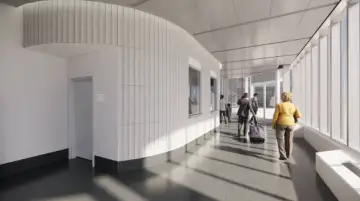
A multi-phase construction process will begin with the sidewalk and exterior work along Easton Avenue and Albany Street, followed by construction of the new ticketing center featuring an elevator and waiting areas, and significant renovations to the historic station building and platforms.
The project, a partnership between NJ Transit and Middlesex County, is out for bid for construction to begin in late fall 2025, with the expectation that all construction will conclude in 2028.
As part of an earlier train station project, vertical circulation improvements - including elevators and escalators - have already been completed.
NJ Transit President and CEO Kris Kolluri also said renovations are planned for the leaky roof, flooding basement, and antiquated sprinkler system.
Kolluri said more than 4,000 people use the New Brunswick Train Station every day, and that number will increase when the three buildings that make up the Health and Life Science Exchange (HELIX) open across Albany Street.
The second phase of the HELIX will be an 11-story, state-of-the-art headquarters in which 1,000 or so Nokia Bell Labs researchers will report to work each day.
The recent opening of the Jack and Sheryl Morris Cancer Center, Rutgers' growing student enrollment, and the city's vibrant dining and entertainment sector will also contribute to the growing number of travelers accessing the New Brunswick Train Station.
"This area will soon be one of the most important destinations for innovation and medical care anywhere in the world," Mayor Jim Cahill said. "The modernization of this station ensures that all this growth is supported by reliable, sustainable, and forward-looking infrastructure. It connects New Brunswick not only to the rest of New Jersey, but also to the entire Northeast Corridor, linking us directly to New York, Philadelphia, Boston, and Washington, DC."
So, Kolluri said the 116 trains that stop at the station each day will pull up to platforms that will be extended to accommodate 12 train cars. By the way, NJ Transit is poised to deploy several new multi-level cars capable of carrying about 140 people each.
While big changes are coming to the New Brunswick Train Station, the orange-brick façade will be retained.
"This is a historic train station, so we and the Middlesex County Improvement Authority are going to work very closely with the State Historic Preservation Office to make sure we're compliant with all the esthetic parts that they want us to preserve," Kolluri said. "I think what you'll end up seeing, the final product, is going to be a context-sensitive project that's going to take into consideration the historic value of the station, but also to make sure the modern amenities blend quite nicely with the historic elements of the station.
Kolluri said NJ Transit will be chipping in up to $60 million to fund the project. In fact, NJ Transit and Rutgers have signed a three-year agreement to make New Brunswick Station the official "Home of Rutgers University." This partnership aims to promote and integrate the university into the heart of the city's transportation hub.
NJ Transit officials said they anticipate welcoming thousands of Rutgers students, faculty, and administrators each day who will pass through the revitalized station.
And the trains will run on time, pledged Gov. Phil Murphy, who joked that he might soon start looking for an apartment in New Brunswick because he seems to attend so many ground-breaking and ribbon-cutting events in the city. The quip got laughs from the audience.
"Does this (the station revitalization) lead to economic activity and development? You bet," Murphy said. "Does it lead to a transportation system that is more efficient? Absolutely. But most importantly, with projects like this, it's quality of life. It's getting home in time to see your kids for dinner. It's getting to work on time in the morning. It's a student getting to or from Rutgers or some other school safely and on time. That, to me, is the real game-changer."
Story By: Chuck O'Donnell
Photo Credit: Middlesex County
About NBCM | Admin Log-in | Privacy Policy | Terms of Use | Accessibility

New Brunswick City Market
P.O. Box 1101
New Brunswick, NJ 08903
Phone: 732-545-4849
citymarket@newbrunswick.com




©2026 New Brunswick City Market, all rights reserved. | A TownSight Website






-flag.jpg)


-flag.jpg)
