Translate 
The Hub is imagined as a two-phase, three- or four-building ecosystem that will foster discovery and collaboration between start-ups and entrepreneurs. It represents a $665 million investment in the areas of innovation, translational research, and medical education in downtown New Brunswick.
Paladino was inspired to help create this 550,000-square-foot development that will be built on about four acres of land across from the train station when he connected two unrelated moments in his life.
First, there was Murphy’s call to supercharge innovation as a job creator in New Jersey. To a developer such as Paladino, who has helped build everything from the New Brunswick Performing Arts Center to New Brunswick High School to the soon-to-be-completed Jack and Sheryl Morris Cancer Center, the governor’s words landed somewhere between a strong suggestion and marching orders.
But then Paladino recalled a conversation he once had with a young Rutgers clinician who was doing diabetes research in her lab.
To take parts of her research out of the academic lab and into a private one to bring her work potentially toward commercialization, she had to get in her car and drive it down to a lab space on Route 1.
“She said, ‘What I should be able to do is go from building to building to building,’” Paladino recalled.
With her frustrations and Murphy’s edict in mind, Paladino was off on fact-finding missions to places such as LabCentral, a shared laboratory facility in the Kendall Square section of Cambridge, Massachusetts, and Pennovation Works, a space with offices, labs, and development spaces on the campus of the University of Pennsylvania in Philadelphia.
Imagine the possibilities, Paladino thought, if you brought together the creative spark of corporate start-ups, the innovation of corporations, and the brainpower of a research university or two?
What Paladino found was that at these places and others, the sharing of ideas and inspiration occurs in the lab, the boardroom, and even in the local coffee shop.
At the hub of The Hub will be public spaces where what he calls “creative collisions” can become an everyday occurrence.
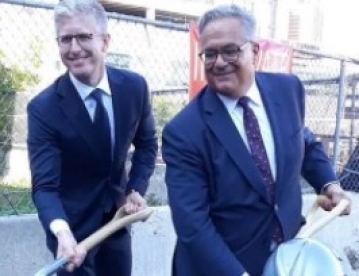
Photo and story by Chuck O’Donnell
About NBCM | Admin Log-in | Privacy Policy | Terms of Use | Accessibility

New Brunswick City Market
P.O. Box 1101
New Brunswick, NJ 08903
Phone: 732-545-4849
citymarket@newbrunswick.com




©2026 New Brunswick City Market, all rights reserved. | A TownSight Website






-flag.jpg)


-flag.jpg)
