Translate 
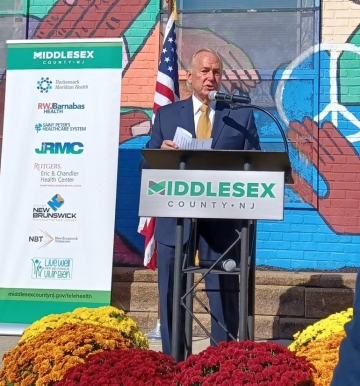
A pilot program unveiled Tuesday will give the city’s Hispanic and Latino communities greater access to telehealth - an emergent technology that proved to be a literal life-saver for an untold number of Americans during the COVID-19 pandemic.
Creating accessible, safe, and confidential pathways for uninsured and underinsured residents to make doctor appointments and health consultations is at the heart of Middlesex County’s Latino Telehealth Pilot Program.
The county will partner with New Brunswick Tomorrow, which will play a vital role in disseminating information about the program through its community ambassadors.
The Latino Telehealth Pilot Program dovetails into New Brunswick Tomorrow’s 45-year mission of raising the quality of all residents’ lives through such things as homeownership education, job training, and, of course, health initiatives.
“There's no question that access to quality health care is a critical component to achieving a high quality of life,” New Brunswick Tomorrow President Jaymie Santiago said. “And as the world embraces more and more digital platforms and virtual connections, we'll set out to bring learnings around how black communities, how brown communities, and how immigrant communities, folks that are often left behind in our country, can best use the services for improving health outcomes. If the pandemic taught us anything, is that these kinds of innovative and equitable initiatives are needed more now than ever.”
Tuesday’s event was held at the New Brunswick Housing Authority headquarters on Van Dyke Avenue, which will, along with the New Brunswick Public Library on Livingston Avenue, serve as coordinating hubs in New Brunswick.
Assemblywoman Yvonne Lopez (D-19) said the program has been a success since last year’s launch in Perth Amboy, where the Raritan Bay YMCA and the Alexander F. Jankowski Community Center have been utilized as sites where residents can access free internet and tech assistance in English and Spanish.
Although the program seeks to break down language and technology barriers, it will help families where both parents work, and getting time off for doctors appointments is not always possible, said New Brunswick, Mayor Jim Cahill.
For others, access to health has been virtually impossible prior to this program, said Manuel Castaneda, the director of community health at New Brunswick Tomorrow.
“A telehealth option can be more than just a convenience,” he said. “It could be the difference in getting people necessary health care when time, transportation, general mobility, and other issues just don’t permit for a face-to-face visit.”
Robert Wood Johnson University Hospital and Saint Peter’s University Hospital have also been tapped as partners in the rollout of this program that will help a community where about a third of the population lives below the poverty line.
For them, said Middlesex County Commissioner and New Brunswick resident Claribel Azcona-Barber, the access the Latino Telehealth Pilot Program provides to specialized and preventative health care will change lives – and save lives, too.
“Imagine having direct access to your doctor from homeless in-person follow-up visits, easier monthly prescriptions, and quicker lab results,” she said.
Story and Photo By: Chuck O'Donnell
About NBCM | Admin Log-in | Privacy Policy | Terms of Use | Accessibility

New Brunswick City Market
P.O. Box 1101
New Brunswick, NJ 08903
Phone: 732-545-4849
citymarket@newbrunswick.com




©2026 New Brunswick City Market, all rights reserved. | A TownSight Website






-flag.jpg)


-flag.jpg)
