Translate 
Otis Tellez, an English major at Rutgers, says he feels as if restaurants and shops are putting out a welcome mat when they have a rainbow sticker in their window.
“I know this is a safe space for me, but not only that, but also, there will be gender-neutral bathrooms here, there will be people that look like me, that are like me in that space, so I feel like I’m more in a community there,” he said.
Posting more rainbow stickers and flags around New Brunswick, and even creating a street mural or two in the familiar colors of the LGBT flag with the goal of fostering visibility and representation, were some of the recurring suggestions at a meeting of city officials, community stakeholders and local leaders on Thursday, Oct. 12.
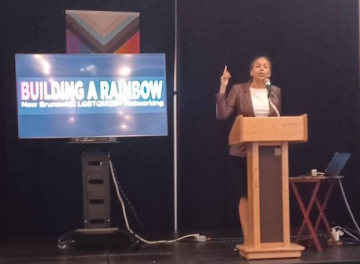
The ‘Building a Rainbow: New Brunswick LGBTQIA2S+ Networking’ event at State Theatre New Jersey was organized by the Department of Human and Community Services under director Keith Jones II and deputy director Edmund DeVeaux.
Representatives of Emanuel Lutheran Church, coLAB Arts, Rutgers’ Center for Social Justice Education & LGBT Communities, and other groups not only spent time forming connections but were asked to brainstorm ideas for events and programming they would like to see in the city. (Several in the room on Thursday, Oct. 12 would like the city to start hosting pride-themed parades down George Street and planning music festivals in Buccleuch Park, just to name a few of the ideas.)
“I think one of the neat things about New Brunswick is that it is a city that unifies a lot of different people and a lot of different interests,” DeVeaux said. “When you look at how diverse the city is, how many partnerships had to be formed to create the HELIX (a massive science and technological ecosystem rising across from the New Brunswick Train Station), how many partnerships had to come together for not just development, but to create the health care city.
“What I see coming out of this is furtherance of that notion of partnership and bringing various aspects of the community together for the betterment of the community,” he added.
DeVeaux said when he joined the Department of Human and Community Services about a year ago, he was handed a folder that contained a copy of the city’s Municipal Equity Index – a measure of how inclusive municipal laws, policies, and services are for the LGBTQ community run by the Human Rights Campaign. Cities are rated based on nondiscrimination laws, the municipality as an employer, municipal services, law enforcement, and leadership on LGBTQ+ equality.
Then, a meeting with some of the members of Emmanuel Lutheran led to the department instituting the first LGBTQIA policy roundtable.
So, it’s no surprise that New Brunswick’s Municipality Equality Index went from a 67 of a possible 100 to 86 in 2024.
Expect that number to keep going up with the city getting behind these sorts of roundtable meetings, said Keywuan Caulk, the director at the Center for Social Justice Education & LGBT Communities.
“I hope that this working group will bring a sense of peace and safety to the city of New Brunswick for folks who identify along the spectrum of gender and sexuality,” he said. “I hope that we are able to bring policy that is already embedded in the city into practice. That means action.”
So, gathering ideas that could promote LGBTQ+ inclusion and connectivity, including a gay dance party at Rutgers’ SHI Stadium, was an important first step.
After one person suggested a gay City Council member, keynote speaker, and Councilwoman Petra Gaskins asked if they would settle for a bisexual one.
“One of the things that came out of the roundtable and why we wanted to do this is because we knew that this portion of the community felt that their voices had not been heard and that they had not been seen, and we knew we could step it up and do better,” said Gaskins, who was joined at the event by fellow Councilmembers Matthew Ferguson and Manuel Castañeda. “So, even though we’re in the mid-90s today, if we can increase our score (on the Municipality Equity Index) a couple of points, by this time next year I hope we’re in the 90s and even score 100.”
Tellez, who identifies as nonbinary, and is transmasculine and queer, said last week’s meeting was important from a social standpoint.
“It’s hard meeting other queer people,” said Tellez, who is also active in the Queen and Christian organization that meets inside the Canterbury House on Mine Street.
“A lot of my friends are queer, but I’m also like, ‘What happens after college? Am I going to meet queer people occasionally?’ So, I think it is just more representation, having flags outside. I like the idea of having the rainbow on the crosswalk as well – just having those colors out there and being with the representation and knowing it’s a safe space out there.”
Story and Photo Credit: Chuck O'Donnell
About NBCM | Admin Log-in | Privacy Policy | Terms of Use | Accessibility

New Brunswick City Market
P.O. Box 1101
New Brunswick, NJ 08903
Phone: 732-545-4849
citymarket@newbrunswick.com


©2026 New Brunswick City Market, all rights reserved. | A TownSight Website





-flag.jpg)


-flag.jpg)
