
Translate 
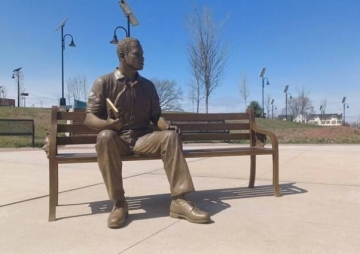
The afternoon sun glinted off the life-sized, lifelike sculpture of Paul Robeson at the entrance of Feaster Park.
Nearby, midday motorists made their way up and down Robeson Boulevard, occasionally breaking the quiet with a somewhat-polite beep or two.
At Rutgers, where Robeson was a consensus All-American football star and the valedictorian of the Class of 1919, a gentle breeze pushed some leaves across a plaza adorned with snapshots of his life.
Soon, these locations in New Brunswick could be appropriate settings for programs and activities each April 9.
In signing Bill AJR-217/SJR-46 on Monday, designating April 9 of each year as “Paul Robeson Day” in New Jersey, Gov. Phil Murphy (D) assured that future state leaders will annually issue a proclamation calling upon public officials, private organizations and New Jersey residents to observe Paul Robeson Day with appropriate activities and programs.
The announcement that the state had designed a holiday for Robeson, who was born April 9, 1898, set officials in motion in New Brunswick, where Human and Community Services Director Keith Jones II began to conjure meaningful ways to mark the day.
Nowhere was the establishment of a Paul Robeson Day met with more enthusiasm than in the school district that proudly boasts the Paul Robeson Community School of the Arts.
“The decision to name one of our district schools in honor of Paul Robeson was an easy one,” New Brunswick Public Schools Superintendent Dr. Aubrey Johnson said. “No one else closely associated with our city was ever more accomplished. He was a renowned singer, an actor, a professional athlete, and an influential activist – in short, he was a remarkably inspiring individual. And while he’s been gone for half a century, he’s as relevant now as ever.”
Keeping Robeson’s legacy relevant seems to be at the heart of creating Paul Robeson Day.
After all, as the bill points out, Robeson not only excelled in the classroom and on the gridiron, but also on the stage. He was one of the most popular concert singers of his time and was one of the first Black men to play serious roles in the predominantly White American theater.
Robeson, however, may have made his biggest impact in the social justice arena, believing that people who ascend to certain societal status have a responsibility to fight for justice and peace.
“Because,” Robeson said, “my father was a slave, and my people died to build this country, and I am going to stay here and have a part of it just like you. And no fascist-minded people will drive me from it.”
It’s not lost on Jones that the creation of Paul Robeson Day comes as some federal initiatives seem to be trying to discourage the teaching of Black history.
For instance, President Donald Trump announced plans to target the federal funding at the Smithsonian’s National Museum of African American History and Culture. And last month, an article on the Defense Department website devoted to Jackie Robinson’s military career disappeared and then reappeared, joining a series of government web pages on Black figures that have vanished under the Trump administration’s efforts to purge government websites of references to diversity and inclusion, the New York Times reported. To that end, Robeson became a firebrand. Called before the House Un-American Activities Committee in 1956, he was asked why he didn’t move to Russia.
“Because,” Robeson said, “my father was a slave, and my people died to build this country, and I am going to stay here and have a part of it just like you. And no fascist-minded people will drive me from it.”
It’s not lost on Jones that the creation of Paul Robeson Day comes as some federal initiatives seem to be trying to discourage the teaching of Black history.
For instance, President Donald Trump announced plans to target the federal funding at the Smithsonian’s National Museum of African American History and Culture. And last month, an article on the Defense Department website devoted to Jackie Robinson’s military career disappeared and then reappeared, joining a series of government web pages on Black figures that have vanished under the Trump administration’s efforts to purge government websites of references to diversity and inclusion, the New York Times reported.
“(The creation of Paul Robeson Day) will require active participation and teaching and sharing information on his life and legacy – which is so interesting right now because you have a time such as now where we’re trying to censor these things,” Jones said. “So, the idea that we’re now honoring the individual that in many cases we’re not even supposed to talk about in terms of the reasons we’re honoring him in an eerie way speaks to exactly who he was and why he was censored in so many ways and ostracized in so many ways.
Story & Photo By: Chuck O'Donnell
“So, it's almost full circle. We're honoring a man who faced such opposition for defending folks all across the world, not just Black folks.”
About NBCM | Admin Log-in | Privacy Policy | Terms of Use | Accessibility

New Brunswick City Market
P.O. Box 1101
New Brunswick, NJ 08903
Phone: 732-545-4849
citymarket@newbrunswick.com




©2026 New Brunswick City Market, all rights reserved. | A TownSight Website






-flag.jpg)


-flag.jpg)
