
Translate 
Dr. C. Roy Epps would have no doubt been touched by the brightly colored mural that was created in his honor and unveiled by city leaders on Wednesday. He just might not have had a lot to say about it.
"He would have thought, 'Another accomplishment,' and then he would have moved on," said his nephew, Ed Spencer. "He was more action than words. He was a man of very few words."
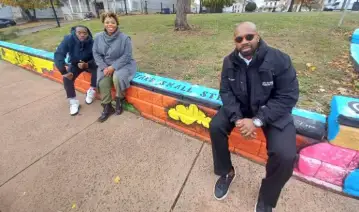
Some of his words, however, have been captured and stenciled into the mural that adorns the 2-foot-tall walls that surround Pittman Park on Handy and Seaman streets.
They're pearls of wisdom, words of encouragement, and other phrases oft-repeated by the man who carved a decades-long legacy as a housing activist, health advocate, and champion for the city's schoolchildren.
On the multicolored wall that runs along Handy Street, there's "Everything happens by opportunity" and "Take small steps."
On the Seaman Street side, there's "Stay on point," "It's good to be seen," and "Decisions don't have to be made within 24 hours."
The city's Department of Human and Community Services under Keith Jones II helped organize the mural, along with support from the Civic League of Greater New Brunswick, the New Brunswick School District, and the Middlesex County Culture and Arts Fund.
Speakers such as New Brunswick Mayor Jim Cahill and Civic League President Zelda Dukes touched on some of the many ways Epps' dogged determination and leadership helped shape the city.
Epps, who died in March at 83, served as the first Black president of the city's Board of Education and president and CEO of the local Civic League. He was a former board member for the New Brunswick Development Corporation (DEVCO), a founding member of New Brunswick Tomorrow, and a driving force behind the founding of the Eric B. Chandler Health Center.
Never one to back down from a fight, Epps waged perhaps no bigger one than in 1974, when the Civic League won a landmark court battle against 23 Middlesex County municipalities for excluding housing for minorities and low-income families - a victory that paved the way for the state's adoption of the Mount Laurel doctrine that requires towns to use their zoning powers to create housing for low- and moderate-income households.
"Dr. Epps dedicated his life to lifting others up, to building a community and to ensuring that every resident was seen, heard and valued," Cahill said. "The message painted, 'It's good to be seen,' captures that perfectly. It reminds us that visibility, acknowledgment, and compassion are at the heart of a strong and healthy community."
Epps would have also, no doubt, been proud of New Brunswick artist Martryce Roach.
She called the process of making the mural "heart work," but it was also hard work. Bending and squatting to apply all shades of spray paint and acrylics after applying a coat of primer was a physical chore. Luckily, she had help from her cousin, Derek, and from the Department of Human and Community Services' Michael Tublin.
But over the course of six days, some local residents came out to cheer her on and even offer her something to eat or drink. A woman stopped to minister to her about the importance of doing God's work.
Roach also saw people dealing with addiction and others who were hungry and homeless in the park that spans about half a square acre and is the final resting place for several Civil War veterans.
She was so moved by their struggles that one morning she came to the park with a suitcase full of toiletries and a few old coats. The contents of the suitcase were gone in minutes, she said.
"I think that my takeaway from this experience is that we need to continue to pour resources into this area," Roach said. "It will be welcomed. It will be appreciated. It will be transformative."
This mural and others created in other places across the city serve as "positive activation," as Jones put it.
"So, if the park is active, if the park is activated positively, then some of these negative things that are happening can't happen in the same space. So, the idea is that we want to invite all of our partners, all of our houses of worship, the community partners, the school district, other agencies, to use the park for passive programming."
Dr. Epps, no doubt, would have approved.
Story & Photo By: Chuck O'Donnell
About NBCM | Admin Log-in | Privacy Policy | Terms of Use | Accessibility

New Brunswick City Market
P.O. Box 1101
New Brunswick, NJ 08903
Phone: 732-545-4849
citymarket@newbrunswick.com




©2026 New Brunswick City Market, all rights reserved. | A TownSight Website






-flag.jpg)


-flag.jpg)
