Translate 
Marcus Williams is one of those boots on the ground, or gravel to be more precise.
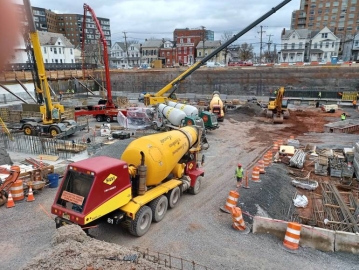
As the trucks hauling tons of crushed stone continue to arrive at the future site of the Jack and Sheryl Morris Cancer Hospital, it’s guys like Williams who are literally building the foundation for the state’s first free-standing cancer hospital.
Williams, his voice rising above the cacophony of growling earthmovers and churning cement mixers, said he and the 70 others donning safety vests and hard hats on Thursday afternoon are taking a little more pride than usual in their work.
Concrete workers, electrical workers, drivers, and others – are all keenly aware that their blood, sweat, and tears through rain, snow, and blazing heat are helping create a place where untold cancer patients will be cared for and the innovations in cancer treatment will be unlocked.
“This just isn’t another office building,” said Williams, who’s doing site work for the project for Branchburg-based excavators Vollers. “This is a cancer hospital. This is extra important.
“Everyone here has the goal of getting this building up as fast as possible so they can help others,” he added. “This is a great project to be part of. So, we bring it every day.”
Gov. Phil Murphy, Mayor Jim Cahill, RWJ Barnabas Health President, CEO Barry Ostrowsky, Rutgers President Jonathan Holloway, DEVCO President Chris Paladino, and other officials took part in the ceremonial groundbreaking in June 2021.
The 510,000 square foot, state-of-the-art facility for cancer treatment and research will be located in the heart of the state that typically ranks in the top 10 in the incidence of the disease and in which some 53,000 people will be diagnosed with cancer this year.
The project has a $750 million price tag attached to it, and at the time of the groundbreaking, the hope was that it would be completed by the end of 2023.
And while so much has already taken shape since that day that Robert Wood Johnson University Hospital Board of Directors Chairman Jack Morris, Middlesex County Commissioner Director Ron Rios, and other officials lined up to break ground with less-than-industrial-grade red and blue blades, an important deadline looms.
Sarah Clarke, executive vice president at DEVCO, said the installation of the structural steel is scheduled to start on April 18.
“So we have to have a certain amount of work done in here because from a safety standpoint, no other workers could go in there until you get a certain amount of work done overhead so that they can safely work on underneath,” said Stan Zelinski, who works for Jingoli, the company that is developing the site.
On April 18, these workers will clear out and the ironworkers will come in and one can imagine this whole site as a large, highly choreographed ballet – although the comparison might get a few raised eyebrows from the guys working here Thursday morning.
With the subterranean parking garage, loading docks, utility plant, and a lead-encased piece of equipment known as a linear accelerator all going into the place at the same time, there’s a lot of cooperation that needs to take place.
“So at the same time you have concrete flooring,” said Clarke. “You have formwork being set. And you just had a load of stone come in. So that’s an example of the coordination it takes down here.”
Of all these moving pieces, the most visible is the tower cranes.
Rising about 400 feet into the New Brunswick air, Zelinski said the one closest to Division Street was put in over the course of a weekend.
They are a design marvel unto themselves, designed to weathervane or spin around in the event of strong winds.
Using this crane, workers have inset some steel piles. Then, it will help put the lead on top of the linear accelerator and for other tasks.
And although the crane looks like some theme park attraction at night, those lights are functional, not decorative. There’s lighting at the top where the operator sits which is required by the Federal Aviation Administration.
“We worked with the hospital (Robert Wood Johnson University Hospital) to provide the additional LED lighting strips that are on the side that give it extra visibility given our proximity to the helipad,” Clarke said.
Story & Photo: Chuck O'Donnell
About NBCM | Admin Log-in | Privacy Policy | Terms of Use | Accessibility

New Brunswick City Market
P.O. Box 1101
New Brunswick, NJ 08903
Phone: 732-545-4849
citymarket@newbrunswick.com




©2026 New Brunswick City Market, all rights reserved. | A TownSight Website






-flag.jpg)


-flag.jpg)
